

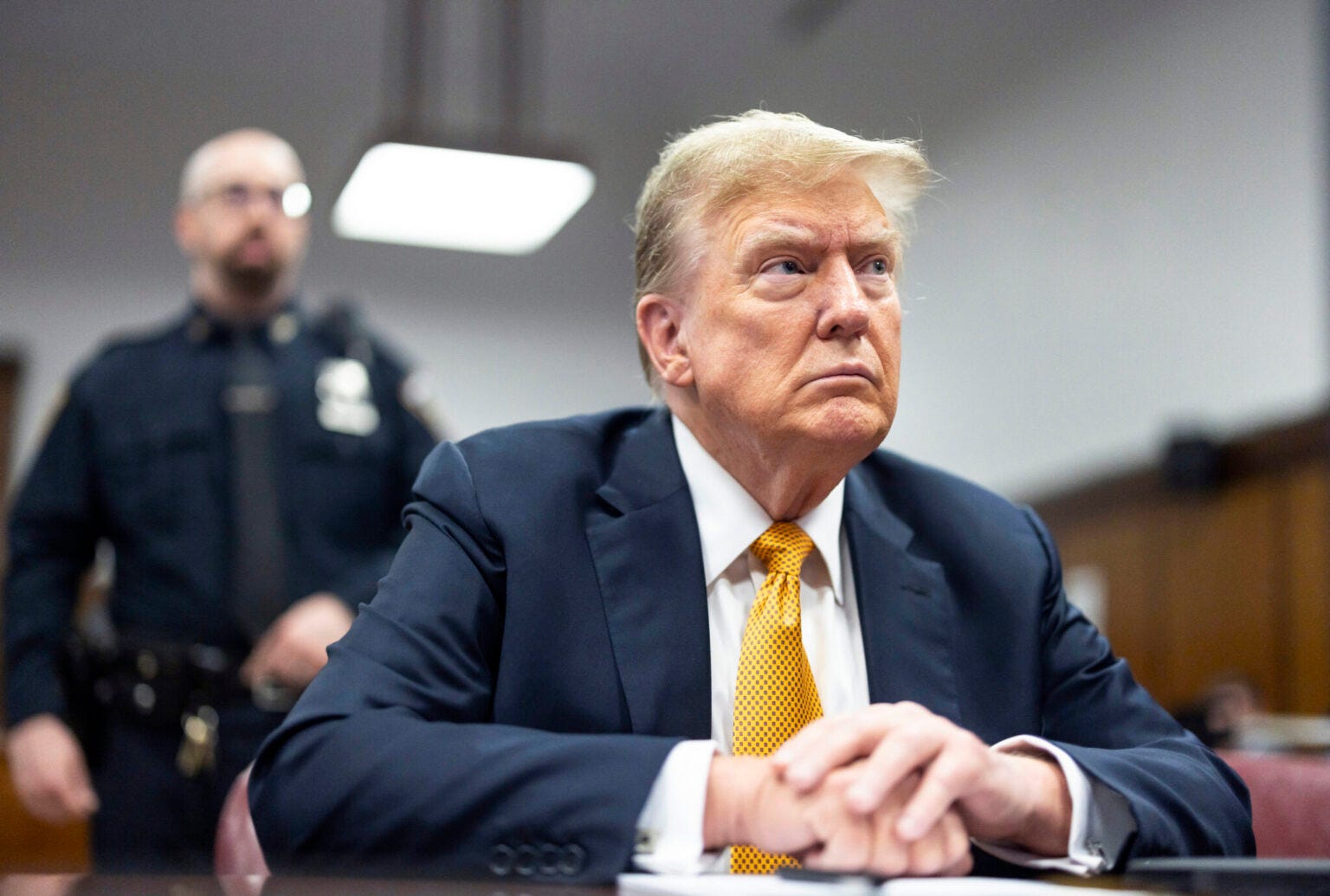
The Question
On December 9, 2019, two FBI agents walked into a strip-mall computer repair shop in Wilmington, Delaware, presented a federal grand jury subpoena, and left with a water-damaged laptop and an external hard drive. They handed the shop’s owner a property receipt. The subpoena had issued from the United States Attorney’s office for the District of Delaware, where a tax and financial investigation of the machine’s owner had been open since 2018, run by a United States Attorney appointed by the sitting Republican president. The laptop’s owner was Hunter Biden, the son of the man who would, eleven months later, be elected President of the United States.
But is there a case to be made that American journalists abdicated their professional responsibility to interrogate their own premises — to identify their biases, question them, and set them aside in their reporting?
Yes, and the case is serious enough that its most damning versions were written by journalists themselves, in flagship publications, in leaked transcripts, in memoirs of exiled editors. The honest answer also requires discipline, because there are two versions of this indictment in circulation and only one of them survives scrutiny.
I.
The first version is the caricature: that sometime around November 2016, American newsrooms collectively decided they were the resistance, adopted a “we are stopping fascism” mission statement, and converted straight news into propaganda. This version is emotionally satisfying and analytically lazy. It commits the same sin it indicts — fitting every data point to a prior narrative, treating the loudest examples as representative, collapsing the distinction between a columnist’s tweet and a front-page news story. If you believe the caricature, you will be unable to explain why the same press corps savaged the Afghanistan withdrawal, why the Wall Street Journal’s verification work on the laptop’s most explosive claim produced a null result that the Journal published anyway, or why the editorial boards of the major papers were brutal about the Hunter Biden pardon in December 2024. The caricature overpredicts. A model that overpredicts is wrong even when it feels right.
The second version is subtler, better documented, and considerably more disturbing, because it does not require a conspiracy. It goes like this: after 2016, American journalism openly renegotiated its relationship with objectivity; the renegotiation shifted not whether skepticism was applied but to whom; contested empirical questions were prematurely reclassified as settled, and dissent from the premature settlement was pathologized rather than reported; the mechanisms driving all of this were sociological and economic — the demographic homogeneity of newsrooms, the death of local media, and above all the shift from advertising revenue to subscription revenue, which converted readers from an audience to be informed into a constituency to be affirmed; and when the failures became undeniable, the corrections arrived late, quietly, and at a fraction of the prominence of the original errors, which is the specific behavior that converts mistakes into breaches of trust.
That second version is the argument of this essay. It runs from the coverage of the Trump presidency through the pandemic’s origin question, through the summer of 2020, through the domains American media learned to call “the culture war,” and it terminates — deliberately — at the Hunter Biden laptop, because the laptop is the case where every thread of the argument converges and where the documentary record is now, thanks to a federal courtroom, essentially complete. Along the way I am going to state the counter-arguments at full strength, because an indictment that cannot survive its own cross-examination is not worth filing, and because the strongest defense of the press’s conduct in this decade is itself part of the story: the defense explains the mechanism.
One more note on method before we begin. Nearly everything in this essay rests on primary documents and the profession’s own literature: leaked transcripts, sworn testimony, court exhibits, cryptographic verification reports, the Columbia Journalism Review, the Shorenstein Center, peer-reviewed studies of media slant, and the confessional essays of the editors who lived it. Where the record is contested, I will say so. Where a claim depends on an allegation rather than a finding, I will flag the difference. The subject of this essay is a profession that stopped doing those things. The essay should not repeat the offense.
II. The Renegotiation
Begin with what happened in the open, because the most important fact about American journalism’s shift after 2016 is that it was not covert. It was argued, published, institutionalized, and defended — which makes it more interesting ethically, not less. “Abdication” implies a duty quietly dropped. What actually occurred was closer to a public renegotiation of the duty’s terms.
The intellectual groundwork predated Trump. Gaye Tuchman’s 1972 paper in the American Journal of Sociology, “Objectivity as Strategic Ritual,” had argued that newsroom objectivity functioned less as an epistemic method than as a professional defense mechanism — a set of rituals (attribution, the inverted pyramid, the dueling quote) that protected journalists from criticism without guaranteeing truth. Jay Rosen of NYU spent the 2000s and 2010s attacking what he memorably called the “view from nowhere”: the pose of positionless neutrality that, he argued, produced stenography rather than verification. And in 2004, Maxwell and Jules Boykoff published “Balance as Bias” in Global Environmental Change, demonstrating that the press’s mechanical both-sidesing of climate science had systematically misinformed readers by presenting a settled scientific question as a live controversy. The critique was real, scholarly, and in important respects correct: balance is not accuracy, and treating it as accuracy is itself a distortion.
What 2016 did was convert that critique from a scholarly corrective into an operational doctrine, applied to a single subject, under conditions of institutional panic. The clearest single statement of the shift came in June 2020, when Wesley Lowery — a Pulitzer-winning reporter — published an op-ed in the New York Times arguing that newsrooms should abandon the “appearance of objectivity” in favor of “moral clarity.” Lowery’s argument was more careful than its slogan: he was attacking performative neutrality, not verification. But slogans travel and arguments don’t, and “moral clarity” became the banner under which a generation of journalists reconceived their role. Three years later, Leonard Downie Jr. — a former executive editor of the Washington Post, which is to say, a man who had spent his career enforcing the old regime — co-authored a study with Andrew Heyward for Arizona State’s Cronkite School titled Beyond Objectivity. They interviewed more than seventy-five newsroom leaders and reported a finding that would have been unthinkable a decade earlier: many of the people running American journalism no longer regarded objectivity as a governing value at all.
Against this stood a rearguard whose most articulate member was Martin Baron, the editor who ran the Post through the Trump years. Baron’s position, developed at length after his retirement, was that the critics had attacked a straw man: objectivity, properly understood, was never neutrality of soul or false balance between truth and falsehood. It was a method — a discipline of verification applied with equal rigor regardless of whose claims were being tested. This is also the position of Bill Kovach and Tom Rosenstiel’s The Elements of Journalism, the closest thing the profession has to a catechism, which traces the term to Walter Lippmann’s insistence in the 1920s that because journalists cannot be objective, their methods must be. On this account, the choice between objectivity and moral clarity was always false. The method produces the clarity; the clarity without the method produces conviction, which is a different commodity.
The analytical framework that best explains what happened next comes from Daniel Hallin’s 1986 study of Vietnam coverage, The Uncensored War. Hallin observed that journalists implicitly sort all claims into three spheres. In the sphere of consensus (the sky is blue, democracy is good), journalists feel no obligation to present opposing views. In the sphere of legitimate controversy (tax policy, foreign intervention), the balance rituals apply. And in the sphere of deviance (Holocaust denial, flat-earthism), journalists feel not merely permitted but obligated to treat claims as illegitimate — to debunk rather than report. The spheres themselves are invisible to the people using them; sorting a claim into one feels like perceiving reality, not making a judgment.
Here is the crux of everything that follows: the placement of claims into spheres is the single most consequential editorial act in journalism, and it is the one journalists least often recognize themselves performing. Nobody at a news meeting says “let us move the lab-leak hypothesis into the sphere of deviance.” The move happens upstream of consciousness, in the aggregate of a newsroom’s assumptions about what sort of people believe what sort of things. When a newsroom is demographically and politically homogeneous — and we will come to the data on that — the sphere boundaries settle exactly where the room’s shared priors sit, and the room experiences its priors as the shape of reality itself.
The post-2016 renegotiation, then, was not primarily a change in what journalists wrote. It was a change in the sphere map. Claims associated with Trump and his coalition migrated wholesale toward deviance, where the both-sides rituals were suspended and the debunking posture engaged — and, crucially, the migration swept up not only the genuinely false (of which there was an unprecedented supply, as we’ll stipulate shortly) but also the contested, the unresolved, and, in at least one spectacular case, the true. Meanwhile, claims aligned with the newsroom’s own consensus migrated toward the sphere of consensus, where skepticism is not applied because applying it feels like debating whether the sky is blue.
That is the disciplined version of the “abdication” thesis. Not that journalists stopped seeking truth — but that they stopped noticing where they had drawn the boundaries of the thinkable, stopped interrogating the drawing, and reclassified the act of interrogation itself as a form of complicity. The rest of this essay is the evidence.
III. The Asymmetry Engine: Covering Trump, 2016–2020
Any account of press conduct in the Trump era has to begin by stipulating the thing that makes the era genuinely hard to adjudicate: the object of coverage was without precedent. The Washington Post‘s Fact Checker database — whatever one thinks of its occasional pedantry — tallied 30,573 false or misleading claims across four years of the Trump presidency. No prior president generated anything within an order of magnitude of that volume. Sixty-plus courts, including judges the president appointed, rejected the stolen-election claims that culminated in January 6. A press corps that had covered that record with mechanical balance — one voice says the election was stolen, another disagrees; you decide — would have committed exactly the “balance as bias” error the Boykoffs documented in climate coverage. When the New York Times made its deliberate, publicly debated decision in September 2016 to put the word “lie” in a headline about birtherism, that was not activism. It was accuracy, arrived at through exactly the kind of institutional deliberation the method requires. The defenders of the post-2016 posture are right about all of this, and any honest indictment concedes it up front.
The indictment begins where the stipulation ends: with the question of whether the response was calibrated to the object or overshot it, and whether the overshoot was ever measured, acknowledged, or corrected.
Start with the aggregate data, because it exists. Thomas Patterson of Harvard’s Shorenstein Center — a scholar who has studied campaign coverage for four decades and whose central finding, long predating Trump, is that press negativity toward all politicians has been rising since the 1970s — measured the tone of coverage of Trump’s first hundred days in 2017. The finding: roughly 80 percent negative, against 41 percent for Obama’s first hundred days, 57 for George W. Bush’s, and 60 for Clinton’s. On some networks the figure exceeded 90 percent. Patterson himself was careful about interpretation: some of that asymmetry reflects the asymmetry of the underlying conduct — a president under investigation generates investigation stories — and some reflects the secular trend he’d been charting for decades. But the residual is large, it was visible across policy domains where the conduct asymmetry was weaker, and — this is the part that matters for our purposes — the profession showed essentially no curiosity about it. An 80-percent-negative tone distribution is either a faithful measurement of an unprecedented presidency or evidence of a systematic instrument error, and a profession serious about interrogating its premises would have wanted very badly to know which. It did not ask.
Then there is the document that tells you what the instrument was doing from the inside. In August 2019, someone leaked to Slate the full transcript of a New York Times town hall in which executive editor Dean Baquet addressed his newsroom in the aftermath of the Mueller report. The transcript is remarkable for its candor. Baquet told his staff that the paper had “built our newsroom to cover one story” — the Trump-Russia story — and that with that story having failed to deliver its anticipated ending, the paper needed to pivot: the next two years, he indicated, would be organized around race and the president’s character, a framing that took institutional form days later with the launch of the 1619 Project. Read generously, this is an editor doing his job — allocating resources against the biggest stories. Read precisely, it is an editor describing narrative-first planning: the arc is selected, then the coverage is built to it. Every journalist knows the difference between following a story and building a newsroom to cover one. The town hall transcript is the rare artifact in which the second posture is described, by the person doing it, in his own words.
The asymmetry engine had a characteristic failure mode at the micro level too, and it’s the one that most corroded ordinary readers’ trust: the treatment of hyperbole. Trump spoke in a register — salesman’s puffery, comic exaggeration, deliberate provocation — that the fact-checking apparatus was structurally incapable of parsing. The result was a genre of correction that literalized the obviously figurative, “fact-checking” statements no listener had taken as factual claims, which taught audiences that the checkers were scoring points rather than protecting truth. The famous 2016 formulation — that the press took Trump literally but not seriously while his supporters took him seriously but not literally — named the problem without solving it. And in fairness, the problem cut both ways: a president who used “I was joking” as a retroactive escape hatch for statements like his invitation to Russian hackers made literalism a defensible default. But the fact-checkers never developed a doctrine for the distinction, and the absence of doctrine meant the calls defaulted to instinct, and instinct defaulted to the room’s priors. A reader could predict, with depressing reliability, which politicians’ exaggerations would be scored as lies and which would be scored as color.
None of this, so far, is the breach. Aggressive, negative, even instinct-driven coverage of a president is within the historical range; presidents from Adams onward have complained about worse. The breach requires something more specific: the migration of open questions into the sphere of deviance, enforced against dissent, uncorrected when wrong. For that, we need the template.
IV. The Template: Russia
The Trump-Russia story is where the post-2016 press earned both its Pulitzers and its autopsy, and the autopsy was conducted, fittingly, by the profession’s own coroner. In January 2023 the Columbia Journalism Review published Jeff Gerth’s four-part, roughly 24,000-word retrospective on the coverage — the most exhaustive internal examination of a single story the field has produced this century. Gerth, a former Times investigative reporter, is not a Trump partisan, and CJR is not a conservative organ; that is precisely what gives the document its weight.
The findings, compressed: major outlets laundered the Steele dossier — an unverified opposition-research product, paid for by the Clinton campaign and the DNC through cutouts — into their news coverage for years, long after its central claims had failed to corroborate. Stories built on it, or on anonymous characterizations of it, were never retracted. The claim that “seventeen intelligence agencies” had assessed Russian interference — repeated endlessly — was false; the assessment came from three agencies plus the Director of National Intelligence. The Alfa Bank server story, published in the closing days of the 2016 campaign, collapsed entirely; the FBI had dismissed it within weeks, a fact that emerged years later in a criminal trial. The Times‘ 2020 story on Russian bounties for American soldiers in Afghanistan — which dominated a news cycle and a presidential debate — was walked back by the intelligence community itself the following spring, which assessed the claim with only “low to moderate confidence”; the walk-back received a fraction of the original’s play. And Justice Department Inspector General Michael Horowitz’s December 2019 report documented seventeen significant errors and omissions in the FBI’s surveillance applications against a Trump campaign aide — findings that vindicated a set of claims the press had spent two years treating as partisan noise, and that landed, again, with a fraction of the prominence of the coverage they discredited.
Two calibrations, because the template only teaches if it’s rendered accurately. First: Russiagate was not a hoax. The Mueller report documented extensive, real contacts between the Trump campaign and Russian-connected figures, a Russian interference operation the report called sweeping and systematic, and multiple episodes of potential obstruction that Mueller pointedly declined to exonerate. The story deserved aggressive coverage. The failure was not that the press investigated; it was that the press pre-concluded — that a substantial portion of the coverage was built backward from an anticipated ending (collusion proven, presidency ended) rather than forward from verified facts, and that when the ending failed to arrive, the apparatus pivoted rather than audited. That is Baquet’s town hall in a sentence.
Second, and more important for everything that follows: notice what the Russia years built. They built a reflex — a fused association between “damaging material about a candidate, of murky provenance, surfacing near an election” and “hostile foreign information operation.” The reflex had a real referent: 2016’s hack-and-leak was genuine, and the press’s role in amplifying the fruits of it genuinely haunted the institutions that had participated. The lesson the profession drew from 2016 was we were used, and we must never be used again. It is one of history’s neater ironies that this lesson — reasonable on its face, penitential in origin — became the loaded mechanism of the decade’s worst failure. An institution that has decided in advance what the next October surprise will be has already decided how it will cover it. The template was set. It waited four years for a story shaped like its trigger.
The Russia years also established the correction asymmetry that will recur through every case in this essay, so let us name it formally here. Call it the prominence ratio: the ratio between the display given an error and the display given its correction. A front-page story walked back in a paragraph on A17 has a prominence ratio approaching zero. Professional ethics codes — the SPJ’s included — require corrections; none requires prominence parity, and the gap between those two standards is where reputations go to survive. Across the Russia coverage, the ratio was consistently, sometimes vanishingly, low: the dossier arrived with sirens and departed in subordinate clauses. Readers noticed. The profession’s trust numbers — we will come to them — are, among other things, the compounded interest on a decade of near-zero prominence ratios.
V. The Substitution Test, and How to Make It Honest
There is a folk instrument for detecting media bias, and everyone reading this has run it: swap the parties. If a Democrat had done this, would the framing be the same? If the victim were white, would the coverage exist? The instrument has a disreputable air — it lives in comment sections — but its legitimacy is conceded by the profession itself, because journalism’s own reform movements are built on it. When Gwen Ifill gave the phrase “missing white woman syndrome” to the profession in 2004, she was running the substitution test on race and victimhood. When newsrooms flagellated themselves during the Gabby Petito frenzy of 2021 — noting, correctly, that hundreds of Indigenous women had gone missing in the same state without a fraction of the coverage — they were running it again, and publishing the results as self-criticism. Nobody gets to certify the instrument when it runs left and confiscate it when it runs right.
What the profession can say — and what must be said to keep the instrument honest — is that in its folk form the test is methodologically weak. It is an uncontrolled thought experiment: you supply the treatment, you imagine the counterfactual, and you grade your own exam, which means the instrument measures the user’s priors at least as efficiently as it measures the outlet’s bias. The remedy is not to discard the test but to discipline it: replace imagined counterfactuals with matched natural experiments — real pairs of events, similar in kind, differing in the political valence of the principals — and measure the coverage on defined observables.
The record contains such pairs, and they are worth examining closely, because they carry the argument that intuition alone cannot.
The cleanest is Tara Reade against Christine Blasey Ford: the same newspaper, the same category of allegation (a decades-old accusation of sexual assault against a man on the threshold of high office), opposite parties. The New York Times covered Ford’s allegation against Brett Kavanaugh within hours of its surfacing in 2018, as did everyone. In 2020, the paper took nineteen days to cover Reade’s allegation against Joe Biden — and when it did, the story initially contained a sentence noting that the Times had found no pattern of misconduct beyond previously reported unwanted hugs and kisses, a clause the paper deleted after the Biden campaign complained. We know this not through inference but through confession: Dean Baquet described the editing sequence, and the campaign’s role in prompting it, on the record, in an extraordinary interview with his own paper’s media columnist, Ben Smith, in April 2020. Baquet’s explanation — that Kavanaugh was already in a public confirmation process while Biden’s situation differed — is an argument, and readers can weigh it. What cannot be argued away is the pair itself: same paper, same allegation class, nineteen-day differential, and a post-publication edit made at the subject campaign’s request, confirmed by the editor. In any other industry, that last item is called customer influence over the audit.
A second pair, humbler but instructive because it involves no allegation at all, only the framing of frailty. In June 2020, Trump descended a ramp at West Point haltingly and used two hands to drink a glass of water; the Times ran a straight-news piece on the episode and the questions it raised about his health, and cable news chewed it for days. In April 2022, a White House staffer in a full Easter Bunny costume physically steered President Biden away from reporters’ questions on the South Lawn. The episode was covered — the claim that it was ignored is false, and the false version of the claim should be retired, because the true version is more damning — but it was covered as whimsy: a light item, a colorful aide, a chuckle. Same category of event (visible presidential handling/frailty, questions about capacity), same outlets, categorical difference in frame. And the Bunny pair matters more in retrospect than it did at the time, because we now know — from the profession’s own subsequent confession, which we will come to — that the frailty it framed as whimsy was the visible edge of the biggest under-covered story of the decade.
A third pair shows that the instrument is content-neutral, which is what saves it from being a partisan cudgel. In November 2021, a man drove an SUV through a Christmas parade in Waukesha, Wisconsin, killing six people; multiple national outlets rendered the event, in headlines and copy, as a tragedy “caused by an SUV” — agency amputated from the driver. Conservatives caught it instantly, and they were right. The mirror-image construction — “officer-involved shooting,” a phrase engineered to remove the officer from the verb — had been caught by the left for a decade, and they were right too. Each camp has perfect vision for the passive voice when the other side deploys it, and perfect blindness when its own side does. The substitution test, run honestly, indicts everyone’s framing reflexes. That is precisely why it is worth running honestly.
Which brings us to the discipline. If you want the test to survive peer review rather than merely a dinner argument, it needs four features. Use matched pairs, not imagined ones — real events, documented coverage. Measure defined observables: coverage volume and placement; agency language (who is the subject of the verbs); source selection (whose experts frame the event); and correction prominence relative to the original error — the prominence ratio again. Pre-register your predictions: write down what coverage you expect before the outcome is known, because retrodiction is where motivated reasoning lives, on every wing. And accept the literature even when it is inconvenient, because some of it is.
Here is the inconvenient literature, stated at full strength. Gentzkow and Shapiro’s 2010 Econometrica study found that newspaper slant tracks the political composition of the paper’s market — consumer demand — far more than the ideology of its owners; slant, in other words, is substantially a product being sold to an audience that wants it, a finding that will matter enormously when we reach the economics. Budak, Goel, and Rao’s large-scale 2016 study found that on most topics, mainstream outlets’ articles were not strongly ideological in their internal framing — the bias, where it existed, lived predominantly in story selection: which events become stories at all. And Hassell, Holbein, and Miles, in a 2020 Science Advances paper, ran actual correspondence experiments on thousands of journalists and found little evidence of partisan gatekeeping in their willingness to cover hypothetical campaign stories — a result any honest critic of the press has to metabolize rather than ignore, even while noting its scope (local political coverage, hypothetical pitches) leaves the biggest national cases untouched.
Read together, the literature and the matched pairs point at the same refined conclusion, and it is the essay’s hinge: the failure of the post-2016 press was not, in the main, slanted sentences. Reporters mostly wrote careful paragraphs. The failure lived one level up, in the decisions that precede sentences — whether something is a story, when it becomes one, which sphere it is filed in, whose denial ends the inquiry, and how loudly the record is corrected when the filing was wrong. Selection, timing, sphere placement, and the prominence ratio: those are the four dials, they are turned before a single word is written, and they are precisely the dials that a homogeneous newsroom turns in unison without experiencing itself as turning anything at all.
Now watch the four dials operate on the three great stress tests: a virus, a summer, and a laptop.
VI. The Virus: Premature Closure as Policy
The pandemic’s origin question is the strongest single exhibit in the case against the post-2016 press, and it is essential to state the exhibit precisely, because the sloppy version of the complaint (”the media said Covid came from nature and they were wrong”) is both unfair and beside the point. Most virologists genuinely favored a natural, zoonotic origin — a spillover from an animal host, most likely at a wildlife market — and they favored it for defensible scientific reasons. Preferring the zoonotic hypothesis was not the error. Zoonosis remains, as of this writing, a leading hypothesis. The error was procedural, and it maps exactly onto Hallin’s spheres: an open empirical question — whether the virus emerged naturally or escaped from a laboratory studying exactly this family of viruses in exactly the city where the outbreak began — was forcibly relocated from the sphere of legitimate controversy, where it belonged, into the sphere of deviance, where dissent is not weighed but excommunicated. And the relocation was not a passive drift of opinion. It was manufactured, by identifiable people, with identifiable conflicts of interest, and then enforced by platforms and amplified by a press that did not examine the machinery it was amplifying.
The manufacturing has a date and a document. In February 2020 — weeks into the outbreak, when essentially nothing was known — The Lancet published a statement by twenty-seven scientists condemning “conspiracy theories suggesting that COVID-19 does not have a natural origin.” A statement in the world’s most prestigious medical journal, framing lab-origin discussion as conspiracy theorizing, functioned as a starting gun: it told every science journalist on earth which sphere the question belonged in. What the statement did not disclose — what emerged only later, through FOIA’d emails obtained by a nonprofit and by congressional investigators — was that it had been organized largely by Peter Daszak, president of EcoHealth Alliance, an organization that had channeled U.S. grant money to the Wuhan Institute of Virology for coronavirus research. Daszak had a direct, undisclosed professional stake in the conclusion that the lab was irrelevant: if the virus had escaped from research his organization had helped fund, the reputational and legal exposure was enormous. The statement was presented to the public and the press as the disinterested consensus of scientists. It was, in part, the interested product of a man with one of the largest conflicts of interest imaginable. The press printed it as the former for over a year.
The enforcement has dates too. In 2020, when Senator Tom Cotton raised the lab-origin possibility, the Washington Post ran a piece describing the hypothesis with language calling it “debunked” and “fringe” and linking it to conspiracy theories — and then, in 2021, quietly appended a correction softening that framing, an admission that the original “debunked” had itself been unwarranted. PolitiFact rated a lab-origin claim “Pants on Fire” false in September 2020, then retired the rating entirely in 2021, conceding the question was unresolved. Facebook announced in February 2021 that it would remove posts claiming the virus was man-made or lab-made — an actual, enforced ban on discussing a hypothesis — and then reversed the policy in May 2021, within days of President Biden’s order that the intelligence community investigate the lab-leak possibility. The sequence deserves to be stated flatly: a hypothesis was declared false by fact-checkers, banned by platforms, and treated as deviance by the press; then, when the sitting Democratic president ordered a formal intelligence review, the same hypothesis was abruptly readmitted to the sphere of legitimate controversy — the president’s action having functioned as a permission slip. The question had not changed. The evidence had not changed. Only the sphere assignment changed, and it changed on a political cue rather than a scientific one. That is the tell. Sphere assignments driven by evidence move when evidence moves. Sphere assignments driven by tribe move when the tribe’s authorities move.
And the underlying question did not resolve toward the settled answer the enforcers had asserted. By 2023, the U.S. Department of Energy had assessed lab-origin as the most likely explanation, at low confidence; the FBI had assessed it as likely at moderate confidence; other agencies favored natural origin, also at low confidence, and the National Intelligence Council was split. In other words: exactly the condition — genuine, unresolved, reasonable-people-disagree uncertainty — that the sphere of legitimate controversy exists to hold. The press had spent 2020 and much of 2021 insisting that the sphere of legitimate controversy was the sphere of deviance, enforcing the boundary against colleagues and readers, and it turned out the boundary had been drawn in the wrong place by a man with an undisclosed conflict of interest, and printed without the scrutiny that the profession’s entire reason for existing is to supply.
Now the correction behavior — the prominence ratio — because it is here that error becomes something worse. When the lab-leak hypothesis was rehabilitated in 2021, there was no reckoning proportional to the enforcement. Outlets that had spent a year calling the hypothesis a debunked conspiracy theory ran measured pieces noting it now merited investigation, as though the earlier certainty had been someone else’s. The fact-checkers retracted specific ratings but not the framework that produced them. No major newsroom conducted, on itself, the kind of autopsy that CJR conducted on Russiagate. The premature closure was reversed; the practice of premature closure — the reflexive filing of a politically-coded empirical question into deviance on the say-so of interested “consensus” — was not examined, and so it remained available for the next question. Which is exactly what a breach of trust is, as distinct from a mere error: an error is a wrong answer; a breach is a wrong answer plus the refusal to investigate the process that produced it, which guarantees the process will produce more wrong answers and signals to the audience that the institution does not consider itself accountable to them.
There is a defense of the pandemic coverage, and it is not nothing. The information environment was genuinely polluted: some lab-leak proponents were also promoting actual nonsense (bioweapon claims, 5G theories, miracle cures), and distinguishing the serious hypothesis from the surrounding noise in real time, under deadline, was hard. Public-health communication faced a real coordination problem: officials worried, not unreasonably, that entertaining lab-origin would fuel anti-Asian violence or undermine compliance with public-health measures. And some of the “just asking questions” around origins was indeed bad-faith cover for xenophobia. All true. But none of it justifies the specific failure, which was not “the press was uncertain” or “the press was cautious.” The failure was that the press was certain in the wrong direction, enforced that certainty against legitimate scientific dissent, derived the certainty from a source it failed to vet, and declined to audit itself when the certainty collapsed. Caution would have been filing the question in legitimate controversy and covering the debate. What actually happened was the opposite of caution: it was the manufacture of false consensus and its enforcement as deviance. That is not an excess of journalistic scruple. It is its absence.
VII. The Summer: Framing at the Edge of the Fire
The summer of 2020 produces the most-quoted single artifact of the entire media-criticism decade, and it is worth dwelling on why. On the night of August 26, 2020, a CNN correspondent stood in Kenosha, Wisconsin, in front of a building fully engulfed in flames and a landscape of burning vehicles, and the chyron beneath him read: “FIERY BUT MOSTLY PEACEFUL PROTESTS AFTER POLICE SHOOTING.” The image became instantly, permanently iconic — the definitive visual of a press caught, on live television, insisting on a frame its own cameras were contradicting. It is the “the sky is aqua, not blue” of the decade: the moment the gap between the narrative and the visible world became a single shareable screenshot.
And here the honest critic has to do something the sloppy critic won’t, because the truth of this case is genuinely more complicated than the screenshot, and the complications matter in both directions.
Take “mostly peaceful” first, on its own terms. As a statistical claim about the summer’s demonstrations in aggregate, it was true. The Armed Conflict Location & Event Data Project (ACLED), a respected academic conflict-tracking organization, analyzed the more than 10,000 demonstrations associated with the Black Lives Matter movement between late May and late August 2020 and found that over 93 percent involved no serious violence, injury, or property destruction. That is a real finding from a serious source, and any account that pretends the entire summer was a nationwide riot is simply lying about the data. Most of the demonstrations were exactly what “mostly peaceful” said: peaceful. The critics who treat “mostly peaceful” as a self-evidently absurd phrase are, on the aggregate numbers, wrong.
The failure was not the aggregate claim. The failure was, once again, one level up — in framing, in juxtaposition, and in what the aggregate claim was deployed to do. Deploying a true statistic about ten thousand demonstrations as a chyron over a specific building that is specifically on fire is not informing; it is using a true general claim to instruct the viewer to disbelieve a true specific image. It is the passive voice of statistics — a technically accurate frame engineered to direct attention away from the thing in the frame. The 93-percent figure describes the summer; it does not describe Kenosha on August 26, and pretending the general dissolves the particular is its own species of dishonesty, distinct from but symmetrical to the right’s dishonesty of pretending the particular is the general.
And there was a particular, and it was large. The same summer produced what the insurance industry recorded as the costliest civil disorder in United States history: the Property Claim Services division of Verisk estimated insured losses from the unrest at between one and two billion dollars — and insured losses systematically understate total losses, because the uninsured and underinsured, disproportionately the small and minority-owned businesses in the affected corridors, don’t appear in the tally. Multiple deaths were associated with the unrest. Downtown corridors in Minneapolis, Kenosha, Portland, and elsewhere sustained damage that in some cases has still not been repaired. This was real, it was severe, and a press that submerged it beneath “mostly peaceful” was not lying with its statistics but was, through selection and framing and juxtaposition, producing in its audience a systematically false impression of the summer’s texture — an impression that the destruction was marginal noise around a peaceful signal, when for the specific communities in the specific corridors the destruction was the signal.
Then there is the episode that did the most damage to the press’s specifically epistemic authority, because it exposed the sphere machinery operating in real time on a question of physical science. In June 2020, more than 1,200 public-health professionals signed an open letter stating that the anti-racism protests should not be curtailed on epidemiological grounds — that they should be supported as vital to public health — and explicitly cautioning against equating them with the anti-lockdown protests that these same professionals had, weeks earlier, condemned as dangerous public-health threats. Read that sequence slowly, because it is the sphere machinery laid bare: the identical physical act — large numbers of people gathering outdoors during a respiratory pandemic — was assigned to the sphere of deviance (reckless, deadly, condemnable) when performed by one political coalition, and to the sphere of consensus (vital, supportable, necessary) when performed by another, and the reassignment was justified not by any change in the virology of aerosol transmission but by the political valence of the cause. And the press, in substantial part, relayed this as though it were a scientific finding rather than a nakedly political judgment wearing a lab coat. The virus does not read protest signs. A profession devoted to interrogating premises would have interrogated that one loudly. Most of it did not.
The counter-arguments here are real and must be granted. The underlying event — George Floyd’s killing, captured in nine minutes of unbearable video — was genuine, and the grief and rage were genuine, and the vast majority of the people expressing them did so peacefully, and a press that had covered the summer as primarily a riot story would have committed exactly the inverse distortion, submerging a true and enormous signal (a historic civil-rights mobilization) beneath a real but smaller one (the destruction). The framing problem cut both ways, and Fox’s summer — which submerged the 93 percent beneath the fires as reliably as CNN submerged the fires beneath the 93 percent — was the mirror-image malpractice, and no honest account gives one a pass. But “both sides framed selectively” is not exoneration; it is a description of a profession-wide failure to hold two true things at once — historic peaceful mobilization and the costliest civil disorder in the nation’s history — which is precisely the failure a serious press exists to avoid. The both-and was available. The reporting, on both sides, chose the either-or that flattered its audience.
VIII. The Culture War: Deviance Assignment as Default
By the time we reach the domains American media learned to call “the culture war,” the pattern is no longer a set of discrete failures but an operating default, and the mechanism is worth naming: on a defined set of identity-inflected questions, the press ceased treating contested empirical and moral matters as belonging to the sphere of legitimate controversy and began treating one side’s position as the sphere of consensus — which meant the other side’s position, and often the underlying facts themselves, were filed under deviance, reported (when reported at all) in the debunking register, and their proponents characterized rather than quoted. The tell, throughout, is the same as in the virus case: when the sphere assignments move on political cues rather than on evidence, and when the corrections (where reality forces them) arrive quietly and late, you are looking at tribe, not method.
Consider the youth gender-medicine question, because it is the case where the reversal is most fully documented and where an American newspaper’s own reporters revolted against their institution’s coverage. For several years, the framing prevalent in much of the American press treated the affirmative model of pediatric gender medicine — social transition, puberty blockers, cross-sex hormones for minors — as settled best practice, with dissent characterized largely as animus, and the underlying evidence base described as robust. Meanwhile, the health authorities of several European countries with nationalized health systems and no American culture-war stake — Sweden, Finland, the United Kingdom — were independently reviewing that same evidence base and reaching a markedly more cautious conclusion. Finland restricted the affirmative model in 2020; Sweden’s Karolinska and then its national board followed in 2021–2022; and in England, the National Health Service commissioned Dr. Hilary Cass, a senior pediatrician with no dog in the American fight, to conduct a systematic review. The Cass Review, published in April 2024, found the evidence base for pediatric medical transition “remarkably weak,” criticized the quality of the underlying studies, and led the NHS to sharply restrict puberty blockers outside research settings. This was not a fringe conservative document; it was a commissioned review by a mainstream medical body in a country whose politics do not map onto America’s.
The revealing American moment came in February 2023, when the New York Times — which had, to its credit, done exactly the kind of careful, evidence-examining reporting on this subject that the moment demanded, notably Emily Bazelon’s long and scrupulous feature — was met not with praise for that reporting but with an open letter signed by hundreds of contributors and allied organizations attacking the coverage as harmful and demanding it change. The paper’s leadership, again to its credit, held firm and defended the reporting. But the episode is a near-perfect illustration of the pressure that produces sphere-collapse: the demand, from inside the extended institution, was that a genuinely contested empirical question — one that mainstream European medical authorities were actively treating as unresolved — be reported as settled, with the unsettled framing itself denounced as a form of harm. The Times resisted; the fact that resistance required editorial courage, and generated an internal revolt, tells you how strong the default toward sphere-collapse had become.
Or consider the narrower, more concrete matter that stands in here for a whole class of school-policy questions — the design and governance of restrooms and locker rooms in public schools when access is decoupled from biological sex. This is a genuinely hard problem with real and competing interests on every side: the dignity, safety, and inclusion of transgender students, which are serious and legitimate; the privacy and comfort concerns of other students and their families, which are also serious and legitimate; and the practical governance questions that fall on school administrators caught between them. It is, in the truest sense, a matter for the sphere of legitimate controversy — reasonable people, arguing in good faith, weighing incommensurable goods. Yet a substantial part of the coverage filed it under deviance: one set of positions was treated as self-evidently correct and compassionate, the competing set as self-evidently bigoted, the parents raising privacy concerns characterized rather than heard, and the empirical questions (about incidence, about implementation, about the actual experiences of the students on every side) largely unexamined because examining them felt like conceding the deviance framing was wrong. The point here is emphatically not that one side’s answer is correct — the point is that a contested moral and practical question was denied the status of contested, and the denial served the priors of the room doing the reporting.
The unifying diagnosis across the culture-war cases is not that the press adopted progressive conclusions — a press is allowed conclusions on its editorial pages, and individual reporters are allowed private views. The diagnosis is structural: the press repeatedly mistook the boundaries of its own newsroom consensus for the boundaries of legitimate debate, filed the resulting questions accordingly, and then — this is the recurring, load-bearing failure — when reality intruded (when European health authorities reached different conclusions, when the Cass Review landed, when a policy’s real-world tradeoffs surfaced), corrected quietly, incrementally, and without ever auditing the reflex that had produced the misfiling. Selection, sphere, source, and prominence ratio — the same four dials, turned the same way, on question after question, by a room that experienced the turning as simply seeing clearly.
IX. Why It Happened: The Mechanism Is Not a Conspiracy
If the argument so far were merely a catalogue of failures, it would be journalism criticism of the ordinary kind — a bill of particulars, easily dismissed as cherry-picking by anyone inclined to dismiss it. What makes it more than that is the existence of a mechanism: a coherent, boringly sociological and economic explanation for why a profession full of intelligent, well-intentioned people produced this specific pattern of failure without anyone ordering it. The mechanism matters because it is the difference between grievance and diagnosis. Grievance says they are lying to us on purpose. Diagnosis says here are the structural conditions under which sincere people reliably misfile reality, and here is why the misfiling runs in a predictable direction. The second is more useful, more defensible, and — for anyone who cares about the institution’s repair — more actionable. It has three components.
The first is composition. American newsrooms are, and have become progressively more, politically and culturally homogeneous. The recurring surveys of American journalists conducted out of Indiana University over four decades — the closest thing the field has to a longitudinal census — document the trajectory: the share of journalists identifying as Republican, never high, fell into the low single digits by the most recent waves, a figure wildly out of proportion to the roughly even split in the general population. And the homogeneity is not only partisan; it is educational, geographic, and class-inflected, concentrated in a handful of coastal metros, credentialed through a narrow set of institutions, and increasingly detached from the regions and social strata it purports to cover. Now recall Hallin: the sphere boundaries are invisible to the people using them; sorting a claim into consensus, controversy, or deviance feels like perceiving reality. A homogeneous room does not experience its shared priors as priors. It experiences them as the shape of the world. When nearly everyone you work with, socialize with, and respect would find a given proposition obviously true or obviously beyond the pale, the proposition’s sphere assignment is made for you, pre-consciously, by the ambient consensus — and the one corrective that could catch the error, a colleague who holds the other prior and says wait, that’s contested, has been selected out of the building. Composition doesn’t make journalists lie. It removes the friction that would otherwise catch the honest mistake.
The second is the collapse of local news, which removed both a check and a ballast. The extinction of local newspapers over the past two decades — thousands of papers gone, whole counties reduced to “news deserts” — did more than destroy accountability journalism at the county courthouse and the school board. It nationalized the profession’s center of gravity. A reporter who came up covering zoning fights and high-school sports and the local water utility in a mid-sized city was exposed, daily, to the concrete texture of ordinary American life and to sources who did not share her priors. That reporter was ballast. As the on-ramp of local journalism disappeared and the surviving jobs concentrated in a few national newsrooms, the profession lost its regular contact with the country it covers and became a closed conversation among people who increasingly resembled one another, talking, in large part, to one another — on the platform we’ll come to in a moment. The check that local reporting provided against metropolitan groupthink was dismantled not by anyone’s design but by the collapse of the advertising model that had funded it, and its loss removed a second source of friction against the misfiling.
The third component is the deepest, because it changed the profession’s incentives at the root: the shift from advertising to subscription. This is Gentzkow and Shapiro’s finding operationalized by economic catastrophe. For most of the twentieth century, the dominant newspaper business model was advertising, and advertising rewards reach: the paper wants the largest possible audience, which means it has a commercial incentive not to alienate any large segment of potential readers, which means — whatever its editors’ private views — it has a structural reason to be, or at least to appear, broadly nonpartisan. The digital collapse of advertising destroyed that model, and the industry’s survivors replaced it with reader revenue: digital subscriptions, memberships, the direct payment of the audience. And reader revenue rewards something entirely different from reach. It rewards intensity. A subscription business does not need everyone; it needs a devoted core willing to pay, month after month, and the way you cultivate a devoted paying core is by reliably affirming its worldview, confirming its priors, and telling it that its enemies are as bad as it fears. The advertising model punished alienating half your potential audience. The subscription model rewards it, provided you capture and intensify the other half. The incentive did not merely permit audience capture. It selected for it.
This is not speculation; it is the thesis of the single most important internal document the decade produced, and it was written by a man with unmatched standing to write it. James Bennet had been the editorial page editor of the New York Times until June 2020, when he was forced out in the uproar over publishing a Senator Tom Cotton op-ed — an op-ed arguing for the deployment of federal troops to quell the summer’s unrest, whose publication triggered a staff revolt on the grounds that it endangered Black colleagues, and whose editor was gone within days. In December 2023, Bennet published a roughly 17,000-word essay in The Economist that is essential reading for anyone trying to understand what happened to American journalism. His central argument was precisely the audience-capture thesis: that the Times, under the commercial pressure of the subscription transition and the cultural pressure of a young, activist, digitally-native staff, had traded the hard discipline of independence for the easier rewards of affirming a like-minded and paying subscriber base — that it had, in effect, allowed its readers and its youngest employees to become a constituency it served rather than a public it informed. Bennet was not a disgruntled outsider throwing stones. He was the person who had run the institution’s opinion operation, describing, from the inside, the incentive structure that had defenestrated him. The audience-capture explanation is not the critics’ theory imposed on the press. It is the press’s own most senior wounded insider’s theory of himself.
Put the three components together and the mechanism is complete, and it requires no villains. A homogeneous newsroom (composition) that has lost its contact with the country (local collapse) and now depends financially on intensifying the devotion of an ideologically sorted paying audience (subscription economics) will, with total sincerity and no coordination whatsoever, systematically misfile politically-coded questions into the sphere that flatters its audience and its own priors — and will experience the misfiling as simply seeing clearly, because the friction that might have caught it (a dissenting colleague, a source from another world, an advertiser who wanted the other half of the market) has been removed at every level. That is why the failures ran in a consistent direction. Not because anyone decided to fight fascism at the expense of the facts, but because every structural pressure on the modern newsroom pushed the sphere boundaries the same way, and nothing pushed back.
X. Where the Indictment Breaks: The Strongest Case for the Defense
An indictment that only prosecutes is propaganda. The argument of this essay is worth making only because it can survive the strongest counter-case, so here is the strongest counter-case, stated without the hedging that usually accompanies concessions offered in bad faith. If you are inclined to accept everything above too easily, this section is the one to read twice.
First, and most important: the model overpredicts, and the places where it overpredicts are load-bearing. If the post-2016 press were simply an anti-Republican, pro-Democratic affirmation machine, it could not have produced the coverage it in fact produced of the Biden administration’s failures — and that coverage was, at key moments, savage. The chaotic withdrawal from Afghanistan in August 2021 was covered by the mainstream press as the debacle it was, with no evident partisan cushioning; the images of Kabul airport and the deaths at Abbey Gate were not softened. The border and inflation were covered as persistent liabilities for the administration, relentlessly. The Hunter Biden pardon in December 2024 — after the president had repeatedly and explicitly promised he would not issue one — drew editorial condemnation from the major boards as sharp as anything they had aimed at the other party. A pure audience-capture-for-Democrats model cannot explain any of this, and intellectual honesty requires holding it against the thesis rather than explaining it away. The refined thesis survives — the claim was always about asymmetry and sphere placement on politically-coded questions, not about uniform partisanship — but the refinement is a real constraint, and anyone who ignores it has stopped doing analysis and started doing advocacy.
Second, the asymmetry of the object was real and large, and it partially justifies an asymmetry of coverage. This bears repeating because it is the concession critics most often skip: 30,000-plus documented false or misleading presidential claims is not a normal baseline, an attempt to overturn a legitimate election through fake electors and pressure on officials is not a normal event, and January 6 is not a normal Tuesday. A press that had covered these with the same tone it used for ordinary political disagreement would have failed in the opposite direction — it would have normalized the genuinely abnormal, committed the “balance as bias” error at civilizational scale, and been rightly condemned for it. Some meaningful portion of the 80-percent-negative tone distribution is not instrument error; it is faithful measurement of an object that genuinely warranted overwhelmingly negative coverage. The honest critic’s claim is not that the asymmetry was wholly manufactured. It is that the manufactured component was real, was never measured or acknowledged, and — critically — swept up the contested and the true along with the genuinely false, because once a subject is filed under deviance the filing applies to everything associated with it indiscriminately.
Third, mechanical balance genuinely is a form of distortion, and the critics of “both-sidesism” are right about that. The Boykoffs proved it on climate. There are questions — the shape of the earth, the safety of vaccines against the diseases they prevent, whether a particular election was stolen — where “presenting both sides” actively misinforms, because one side is simply factually wrong, and the journalistic obligation is to say so. The renegotiation of objectivity was, in part, a response to a real defect in the old regime: the pretense that truth always lives at the midpoint between two claims is itself false, and sometimes dangerously so. The failure was not the recognition that some questions have a right answer the press should state. The failure was the promiscuous extension of that recognition to questions that did not have a settled right answer — the treatment of the contested (lab origin, youth gender medicine, the tradeoffs of a school policy) as though it were the settled (the shape of the earth). The tool was sound. It was applied to the wrong screws.
Fourth, most reporters, most of the time, wrote careful and accurate paragraphs. The measurement literature supports this: the bias, where it existed, lived predominantly in selection, timing, sphere placement, and correction prominence — the decisions around the sentences — not usually in the sentences themselves. This matters for fairness to individuals: the sweeping claim that “journalists are propagandists” is false and unjust to thousands of people doing careful work under difficult conditions. The structural critique is precisely a structural critique — it indicts a system of incentives and its aggregate output, not the integrity of the median reporter. Anyone who converts “the institution’s incentives reliably distort its aggregate coverage in a predictable direction” into “journalists are liars” has coarsened a true and subtle claim into a false and stupid one.
And fifth — the point that must never be dropped from the mouth of anyone making this argument in good faith, and the reason the substitution test is a mirror before it is a weapon: the exact same analysis, run on the right-leaning media ecosystem, returns a verdict at least as damning. Fox’s coverage of the 2020 election fraud claims was so detached from reality that the network paid $787.5 million to settle Dominion Voting Systems’ defamation suit rather than face a jury, and the discovery in that case revealed hosts privately deriding, in their own text messages, the very claims they were broadcasting to their audience as fact — a form of audience capture so pure it crossed into knowing falsehood, which is worse than anything documented on the other side. The right-leaning ecosystem submerged the 93 percent beneath the fires as reliably as the left-leaning one submerged the fires beneath the 93 percent. If this essay concentrates its fire on the mainstream, legacy, prestige press, it is not because that press is the worst offender in some absolute sense. It is because that press claims the mantle of objective, non-partisan, methodologically rigorous journalism — it asks to be trusted as the neutral arbiter — and the gap between that claim and the conduct is therefore the more consequential breach. Fox never promised to be the view from nowhere. The Times did. A broken promise is a graver thing than a promise never made.
Hold all five of these. They do not dissolve the indictment; the indictment was constructed to survive them, and the surviving core — asymmetric sphere placement on politically-coded questions, driven by a nameable mechanism, uncorrected by a profession that refused to audit itself — stands after every concession is granted. But an indictment that has genuinely metabolized its own strongest counter-case is a different and more dangerous thing than one that hasn’t. It can no longer be dismissed as the other tribe’s grievance, because it has already said, out loud, everything the other tribe would say in rebuttal, and it is still standing.
XI. The Confession: The Age Story
Before the laptop, one more case, because it does something none of the others quite do: it ends in the profession’s own signed confession, and the confession was delivered, without apparent irony, by some of the same people who had enforced the silence it confessed to. The story of President Biden’s cognitive decline, and the press’s coverage of it, is the closest thing this decade offers to a controlled demonstration of the entire thesis — misfiling, enforcement, collapse, and belated confession — with the added feature that the confessors indicted themselves.
For most of Biden’s presidency, questions about his acuity were filed, by much of the mainstream press, under deviance. To raise them was coded as a Fox News talking point, a right-wing smear, “cheap fakes” — a term the White House deployed and much of the press adopted — a genre of bad-faith attack rather than a legitimate line of inquiry into the capacity of the most powerful person on earth. Reporters who pursued the story encountered not only White House stonewalling but peer pressure: to cover Biden’s age seriously was to risk being sorted, by one’s own colleagues, into the wrong tribe. When the Wall Street Journal published a deeply-reported piece in June 2024 documenting, from numerous sources, concerns about Biden’s diminished capacity in private meetings, the story was met not with a collaborative rush to match and extend it — the normal response to a rival’s scoop on a matter of supreme public importance — but with a coordinated dismissal, from the White House and from much of the rest of the press corps, as a partisan hit job built on Republican sources. The sphere machinery again: a legitimate empirical question about presidential capacity, filed under deviance, enforced against the colleagues who tried to report it.
Then came the debate of June 27, 2024, and the sphere collapsed in ninety minutes of live television, in front of tens of millions of people, exactly as the Kenosha frame had collapsed in a single chyron. The reality the frame had been suppressing became undeniable because it was broadcast, unmediated, to the entire electorate at once. And the press pivoted — hard, fast, and without visible reckoning for the years of suppression that had preceded it. Within weeks the same institutions that had dismissed the Journal‘s June reporting were running relentless coverage of Biden’s fitness, coverage that contributed materially to his withdrawal from the race in July. The story that had been deviance in May was wall-to-wall in July, and the evidence had not changed in the interval — only the permission to see it had, granted by an event too public to spin.
And then, in 2025, the confession. Jake Tapper of CNN and Alex Thompson of Axios published Original Sin, a book documenting, in detail, the concealment of Biden’s decline — the managed schedules, the limited exposures, the inner circle’s protective apparatus — and, implicitly and sometimes explicitly, the press’s failure to penetrate it. The book was a bestseller and a sensation. But its deepest significance is in the identity of its authors and the arc of their own conduct. Tapper, accepting an award at the White House Correspondents’ Association dinner years earlier, had rebuked a Trump surrogate on air in 2020 for raising Biden’s cognitive state; he had been, in his own on-air conduct, part of the enforcement. Alex Thompson, accepting a press award in 2025 for his reporting on Biden’s decline, said from the podium, in front of the assembled Washington press corps: “We, myself included, missed a lot of this story, and some people that are still in this room, some people that are still on the payroll, were part of a massive cover-up.” Read that again. The confession was delivered to the profession, by a member of the profession, at the profession’s own annual celebration of itself, and it named the cover-up as ongoing and internal.
Here is why the age story is the decisive bridge to the laptop, and why it belongs immediately before it. It demonstrates, with the profession’s own signature at the bottom, every element of the thesis: a legitimate question misfiled as deviance; the misfiling enforced against colleagues who tried to report accurately; the enforcement sustained by tribal coding and White House pressure rather than by any honest assessment of the evidence; the sudden collapse of the frame when reality became too public to suppress; the pivot executed by the same personnel who had enforced the silence, without proportional reckoning; and finally, uniquely, an explicit confession — years late, delivered by the enforcers themselves, and monetized as a bestseller, which is its own dark comment on the incentives. The age story proves the mechanism is real, because the people inside it eventually said so. And it establishes the essay’s core distinction one final time before the climax: the failure was not the initial misjudgment — everyone misjudges — but the enforcement of the misjudgment against those who saw correctly, and the lateness and self-serving framing of the eventual correction. Lateness is the charge. It is the charge because it is the one the record proves, in the profession’s own hand, at the profession’s own podium.
Now, with every thread drawn — the renegotiation, the asymmetry, the template, the disciplined test, the virus, the summer, the culture war, the mechanism, the counter-case, and the confession — we can finally take up the story where all of them converge, and where the record is not an allegation, or a study, or a memoir, but a federal court exhibit.
XII. The Laptop, Part One: The Timeline the Record Now Fixes
We return to the strip mall in Wilmington, and to the machine the FBI carried out of it under subpoena on December 9, 2019. What follows is the chronology, and it must be laid down with precision, because the singular feature of the Hunter Biden laptop story — the feature that separates it from every other case in this essay and elevates it from error to something without precedent — is that nearly every load-bearing fact in it now rests not on journalism, not on anonymous sources, not on contested studies, but on sworn testimony and physical exhibits entered into evidence in a federal criminal trial. This is the one case where we do not have to argue about what happened, because a United States courtroom established it under the rules of evidence, with the penalties for lying attached.
The provenance chain: In April 2019, a water-damaged MacBook Pro was left at a computer repair shop in Wilmington, Delaware, under a signed work-authorization form containing a standard clause providing that equipment not reclaimed within ninety days would be treated as abandoned. It was never reclaimed. The shop’s owner, in the course of attempting to recover the failing drive’s data for the customer, encountered its contents. In the fall of 2019, alarmed, he brought the material to the attention of the FBI — his father, a retired Air Force colonel, initially making the approach to a field office. On December 9, 2019, FBI agents served a federal grand jury subpoena and took possession of the laptop and an external hard drive, leaving a property receipt. The subpoena issued from the office of the United States Attorney for the District of Delaware, David Weiss — a Trump appointee — whose investigation into the younger Biden’s taxes and finances had been open since 2018.
Every element of that paragraph is now confirmed in the trial record. At Hunter Biden’s federal gun trial in Delaware in June 2024, FBI Special Agent Erika Jensen testified, under oath and subject to cross-examination, that the Bureau had obtained the laptop by grand jury subpoena in December 2019, that its contents were consistent with data from Biden’s own Apple iCloud account, and that there was no evidence the device had been tampered with or its data manipulated. The Justice Department, prosecuting the president’s son, introduced the physical laptop into evidence and relied on data drawn from it to help prove its case. And the defense — Hunter Biden’s own lawyers, who had spent the preceding years insinuating in letters and civil filings that the laptop’s data had been “manipulated” — did not, in the courtroom, where frivolous claims carry sanctions and assertions must be backed by proof, contest the authenticity of the device or its data. When both adversaries in a criminal proceeding treat a piece of evidence as genuine, the authenticity question is not merely answered; it is closed by the most rigorous truth-finding procedure the society possesses.
That closure was not available only in 2024. It is essential to the indictment that the knowability long preceded the courtroom. Consider what was on the public record in October 2020, when the story broke and the suppression began. The subpoena and the property receipt — government documents — were referenced in the New York Post‘s original reporting. The Director of National Intelligence, John Ratcliffe, stated publicly on October 19, 2020, that the laptop was “not part of some Russian disinformation campaign.” The following day, October 20, the FBI wrote to Senator Ron Johnson stating that it had nothing to add to Ratcliffe’s characterization — a conspicuous non-contradiction from the one institution that actually possessed the device and had possessed it for ten months. Tony Bobulinski, a former business associate of Hunter Biden’s, went on the record — on camera, using his real name, describing specific business dealings and the family’s involvement — before the final presidential debate. And the cryptographic means of verifying a large tranche of the emails — the DKIM signatures we will come to — were sitting inside the files the entire time, available to anyone with the will and the technical competence to check them, which every major newsroom possessed.
So the timeline fixes two things at once. It establishes, beyond argument, that the data was authentic and the underlying probe real and predating any political actor. And it establishes that the tools to establish authenticity were available in real time, in October 2020, to any organization that chose to use them. The 2024 trial did not create the truth. It removed the last conceivable excuse for not having found it four years earlier. Which means the failure that occurred in October 2020 was not a failure of available information. It was a failure of will — a choice, made under the influence of the mechanism this essay has spent its length describing, not to look. And that is a different and graver category of failure than any we have examined, because in every prior case the press could at least claim the truth was genuinely uncertain at the time. Here, uniquely, it was checkable, and the checking was declined.
XIII. The Laptop, Part Two: The Machinery of Suppression
What happened when the story broke is best understood as the loaded template from the Russia years firing on a story shaped precisely like its trigger — with the crucial and catastrophic difference that this time the story was true. Recall the reflex the profession had built: damaging material about a candidate, of murky provenance, surfacing near an election, equals hostile foreign information operation, and our sacred duty — learned in the penance of 2016 — is to refuse to be used. Now observe how perfectly the laptop’s surface features fit the trigger, and how that fit pre-coded the entire response before a single fact was examined.
The story arrived through the worst possible courier. It came via Rudy Giuliani, the president’s personal attorney, who had spent the previous year openly seeking damaging material on the Bidens in Ukraine — the very conduct at the center of the first impeachment. Weeks before the laptop surfaced, the Treasury Department had sanctioned a Ukrainian member of parliament, Andrii Derkach, for running an influence operation that laundered anti-Biden material through American intermediaries including Giuliani. The material concerned Burisma and the Bidens — the exact subject of the impeachment that had consumed the prior year. Every surface feature screamed this is the trigger. The courier was a known operative in a foreign influence context; the subject was the impeachment’s subject; the timing was three weeks before an election. If you had designed a true story specifically to be mistaken for a Russian operation, you could not have improved on the laptop’s packaging. And the profession, primed by four years of the Russia template and the penance of 2016, read the packaging and never opened the box.
The suppression then proceeded through an apparatus that had not existed in any prior era — and cataloguing its components is the whole point, because it is the novelty of the apparatus that makes the episode unprecedented. Three layers operated in concert.
The platforms moved first and hardest. Twitter blocked all links to the New York Post‘s story — users could not share it, could not direct-message it; the URL was treated as malware — and then locked the Post‘s own account, the account of the country’s fourth-oldest newspaper, for roughly two weeks, under a “hacked materials” policy. Facebook, acting on generic advance warnings from the FBI about anticipated hack-and-leak operations, throttled the story’s distribution algorithmically while its own third-party review proceeded, suppressing its reach at the decisive moment. Jack Dorsey, Twitter’s CEO, would later call the blocking a mistake; Mark Zuckerberg would later describe, in his own account, the FBI warnings that had prompted Facebook’s throttling. But the mistake was made when it mattered — in the window before an election — and unmade only after, when unmaking it cost nothing.
The intelligence establishment supplied the frame. On October 19, 2020, fifty-one former senior intelligence officials — former CIA directors among them — signed a public letter stating that the laptop story “has all the classic earmarks of a Russian information operation.” The letter’s careful readers noticed what its headline readers did not: it explicitly conceded that the signatories had no evidence of Russian involvement. It was, on its face, a statement of suspicion by people with no access to the actual device, dressed in the authority of their former titles. But the hedge was invisible at the speed of a news cycle, and the press converted “these former officials, lacking evidence, suspect Russian involvement” into “intelligence officials say: Russian disinformation,” a settled descriptor, almost instantly. The letter was, in the most precise sense, laundered authority: it took a political judgment (this hurts our preferred candidate and should be discredited) and passed it through the prestige of the intelligence community to emerge as something that looked like an intelligence finding, which it explicitly was not. We later learned, from Michael Morell’s sworn testimony to the House Judiciary Committee, that the letter’s organization had been prompted by a call from the Biden campaign — from Antony Blinken, then a campaign adviser — and that Morell’s purpose in helping to organize it was, in his own testimony, to aid Biden in the upcoming debate and to give then-candidate Biden a talking point. The frame was not an independent assessment that the press dutifully reported. It was, per the sworn account of one of its own authors, opposition messaging wearing the borrowed uniform of the intelligence services, and the press wore the uniform’s authority without checking who was inside it.
The press itself then completed the circuit. The frame the platforms enforced and the officials supplied was ratified by the coverage. The story was widely characterized across mainstream outlets as “Russian disinformation” — not as an unverified story requiring investigation, but as a known falsehood requiring debunking. The public radio network’s managing editor publicly explained that the outlet would not devote resources to what it characterized as a distraction not worth its listeners’ time. A network anchor, interviewing the sitting president, told him flatly that the laptop material “can’t be verified” — a statement that was true only in the sense that the network had not tried to verify it, and false in the sense that verification was available. The story was filed, wholesale, into the sphere of deviance, and the debunking register engaged, and the reporters who might have opened the box instead spent their energy explaining why the box should not be opened.
And here is the asymmetry that transforms all of this from an ordinary misjudgment into the decade’s signature hypocrisy — the point where the substitution test, run against the profession’s own prior conduct, returns its most damning verdict. The chain-of-custody scruples, the provenance concerns, the sudden fastidiousness about “hacked materials” and unverifiable data that the press and platforms discovered in October 2020 — where had all of that rigor been during the Steele dossier? The dossier was an unverified opposition-research document, paid for by the opposing campaign, of exactly the murky provenance now cited to bury the laptop, and the press had mainlined it into years of coverage without a fraction of this care. The same institutions that laundered an unverified oppo document into the news when it damaged Trump refused to examine an authenticatable laptop when it damaged Biden. That is not a defensible application of consistent standards under difficult conditions. It is the selective deployment of a standard as a weapon — rigor summoned to suppress inconvenient truth and dispensed with to amplify convenient suspicion — and it is precisely the pattern that a decade of near-zero prominence ratios had trained the audience to expect. The laptop did not create the profession’s credibility problem. It proved the audience had been right about it all along.
XIV. The Laptop, Part Three: Authenticity, Forensics, and the Death of the Fabrication Theory
For the indictment to hold at full strength, one objection must be met head-on rather than waved past, because it is the objection the suppression rested on and the one a fair-minded reader will still be harboring: maybe the caution was warranted; maybe the data really was suspect. The forensic record answers this decisively, but answering it requires a distinction that the entire episode blurred and that professional practice keeps rigorously separate — a distinction worth teaching slowly, because it is the crux.
The authenticity of the data — was this really Hunter Biden’s email, his photographs, his text messages? — and the chain-of-custody integrity of a particular physical copy of a hard drive — can we certify that this specific disk image, having passed through these specific hands, was altered by none of them? — are two different properties, established by two different methods, and confusing them is the error at the heart of both the suppression and its later, sloppier defenses. They must be held apart.
Start with the data’s authenticity, because the evidence for it is overwhelming and comes from multiple independent directions. When the Washington Post finally commissioned its own forensic examination — published in March 2022, seventeen months after the story broke — its outside experts, Matt Green of Johns Hopkins and Jake Williams, a former NSA analyst, were able to cryptographically validate nearly 22,000 of the emails on the drive using DKIM signatures. DKIM — DomainKeys Identified Mail — is a system by which a sending mail server attaches a cryptographic signature to each message; the signature can later be checked against the server’s public key to prove the message is authentic and unaltered. Crucially, DKIM signatures survive copying: a validly-signed email remains provably genuine no matter how many times the file containing it is duplicated, because the proof is mathematical and travels with the message. This is why nearly 22,000 emails could be proven authentic even off a drive that had been handled carelessly — and it is why, within days of the original October 2020 story, an independent security researcher had already cryptographically validated the single most important email on the drive, the central Burisma “thank you” message, and published the verification. The tool that settled the question in 2022 existed, and was used by at least one competent outsider, in 2020. The newsrooms that possessed the same capability chose not to deploy it.
The DKIM validation is corroborated from other directions, which is how forensic confidence is properly built — not from one proof but from the convergence of independent ones. Ben Schreckinger, a Politico reporter, independently corroborated key emails through their recipients and, in one case, through a foreign government’s document release, and documented this in a 2021 book. CBS News commissioned its own forensic examination, published in November 2022, using a copy obtained directly from the shop owner — upstream of Giuliani — and its firm found the drive consistent with normal use, with no evidence of tampering. The iCloud match testified to at trial provides yet another independent line: the laptop’s contents aligned with data Apple produced to the government under a separate warrant. And then there is the most quietly conclusive corroboration of all, the one that requires no forensic expertise to grasp: Hunter Biden’s own legal conduct. His lawyers pursued a privacy lawsuit and sent letters to the Justice Department demanding criminal investigation of the individuals who had disseminated his data — a legal posture that is coherent only if the data is his. You cannot sue for the invasion of your privacy through the exposure of data you contend is fabricated. The possessive pronoun in his own lawyers’ filings concedes the entire question of authenticity.
Now the other property — the chain-of-custody integrity of the copies — because this is where honesty requires a genuine caveat, and where the caveat’s precise scope must be understood, because the episode’s tragedy lives exactly here. The Washington Post‘s 2022 examination, having validated the 22,000 emails, also reported that the large majority of the drive’s 217 gigabytes could not be independently verified — not because it showed signs of fabrication (the examiners found no evidence of that anywhere) but because the copies had been handled in ways that destroyed the ability to certify their integrity: the data had been accessed and copied repeatedly without write-blockers (devices that prevent any alteration during forensic copying), metadata was damaged or missing, and some files bore modification dates that postdated Hunter Biden’s possession of the laptop and even the FBI’s seizure of it — artifacts of the careless copying, not evidence of planted content, but fatal to certification nonetheless. The public corpus was, moreover, composite and messy: it descended from a technician’s manual salvage of a failing drive rather than a hashed forensic image; it passed from the shop owner to Giuliani’s associate Robert Costello, then to Giuliani and Steve Bannon, then to the Post, and separately to others — Jack Maxey, the group Marco Polo — who made further copies of copies; it included an encrypted iPhone backup that a third party later cracked with commercial tools; and public discussion intermittently blended in material from an entirely different Biden laptop that the DEA had seized from a doctor’s office in an unrelated matter.
So the honest formulation — the one that neither suppresses nor overclaims, and the one the press owed its readers in 2020 and never delivered — is this: the data was authentic, proven so by cryptography, corroboration, an iCloud match sworn to in federal court, and the subject’s own legal conduct; and separately, the specific nth-generation copies that circulated publicly had been handled so carelessly that no examiner could affirmatively certify every file on them, though no examiner found any file to be fabricated either. “Unverifiable,” properly understood, described the custody of certain copies, not the authenticity of the data — and the collapse of that distinction was the engine of the whole disaster.
Which brings us to the death of the fabrication theory, and to an irony that ought to be dwelt upon, because it inverts the entire moral structure of the episode. Notice whose theory required tampering. It was never the theory of the story’s defenders. The theory that the laptop had been fabricated, doctored, or planted was the implicit theory of the fifty-one officials’ letter (”classic earmarks of a Russian information operation”) and, later, the explicit theory of Hunter Biden’s own lawyers, who used the word “manipulated.” That theory — the suppression’s foundational premise — has now been tested for more than four years, by multiple independent forensic examinations, by adversaries on every side with maximal incentive to prove it, in a criminal proceeding where the defense could have raised it under oath and chose not to. The number of demonstrated forgeries produced by all of that scrutiny stands at zero. Not “few.” Zero. That is about as strong as negative evidence ever gets in the real world: a claim, held by powerful institutions, with every resource and incentive to substantiate it, tested exhaustively for years, yielding not one confirmed instance. The fabrication theory did not merely fail to be proven. It was affirmatively falsified by the totality of the forensic and legal record.
But — and this is the lesson that generalizes beyond the laptop into the whole practice of journalism — the residue of the sloppy custody is permanent, and it functioned as the suppression’s own life-support system. Because a handful of files on the circulated copies can never be affirmatively certified, the phrase “may be manipulated” retained a sliver of technical defensibility, and that sliver was enough to sustain the deviance framing for cycle after cycle. Every unhashed transfer, every copy made at a kitchen table without a write-blocker, every careless handling by Giuliani’s circle bought the dismissers another news cycle of “unverified.” The poor custodianship of the material became, in effect, the story’s own suppressor — the mechanism by which a true story was kept unusable. And that is a media-ethics lesson of the first order, one that indicts the story’s clumsy handlers alongside its motivated suppressors: how you handle true material determines whether the truth is usable. A true story delivered through a contaminated chain of custody, by a compromised courier, into a press primed to disbelieve it, can be true and buried at the same time. The laptop was.
Run the substitution test on the caveat itself, to be sure it is principle and not special pleading — because the test’s final discipline is that it must be applied to one’s own reasoning, not only to one’s opponents’. If a drive belonging to Donald Trump Jr. had spent a year being copied hand-to-hand through a Democratic operative’s circle before publication, every fair analyst would demand exactly this asterisk on the unverified portions — and would be right to. The asterisk is not hedging; it is the consistent application of forensic standards regardless of whose data is at stake. But — and here the stipulation that governs this essay’s conclusion takes hold — the asterisk shrinks to a footnote, and then to nothing of real consequence, the moment an honest observer registers what the courtroom established: that the FBI held the laptop from December 2019, that the Bureau raised no objection to the validity of its data, and that the Justice Department itself put that data before a jury as evidence in a federal criminal trial. Once the government’s own prosecutors are entering the material into evidence against the president’s son, the fastidious concerns about provenance that justified two years of suppression are revealed as what they always were: not a standard, but a pretext.
XV. The Laptop, Part Four: The Third Ring, and the Problem of the State
There is a layer to the laptop story that most media criticism omits, and omitting it flatters the press by making the failure smaller than it was. Without this layer, the laptop is a two-institution problem: the press and the platforms failed. With it, there are three concentric rings of failure, and the innermost ring is the state itself — which changes the episode from a media scandal into something closer to a civic one, and which is necessary to understand before the final judgment, because it both deepens the indictment and complicates the assignment of blame.
For the ten months between the FBI’s seizure of the laptop in December 2019 and the Post‘s publication in October 2020, one institution in America possessed ground truth. The federal government had the physical device. Its own investigators had, according to the later congressional testimony of IRS case agents, treated the data as authentic — matched to Biden’s Apple account — well before the story became public. When the decisive moment arrived — the morning of October 14, 2020, when Twitter’s head of site integrity, Yoel Roth, reached out to his FBI contacts to ask, in effect, is this thing real? — the government that had held the answer for ten months gave, in substance, no comment.
That silence did not stand alone. It coexisted with a season of affirmative shaping by the same government that was declining to confirm. Roth would later state, in a sworn declaration to the Federal Election Commission, that in the run-up to the election the FBI had warned the platforms to expect a hack-and-leak operation and that these warnings had specifically primed him to anticipate a leak involving Hunter Biden. FBI agent Elvis Chan, deposed in the Missouri v. Biden litigation over government-platform coordination, confirmed the cadence of federal warnings to the platforms in the relevant period. In September 2020, a month before the story broke, the Aspen Institute convened a tabletop exercise — a scenario-planning war game — that rehearsed, with platform executives and journalists in the room, the handling of a hypothetical leak of damaging material about “Hunter Biden” involving Burisma. And in August 2020, the FBI had given a defensive briefing to Senators Ron Johnson and Chuck Grassley suggesting that their own Burisma-related inquiry risked being a vehicle for Russian disinformation — a briefing the senators protested in writing as gratuitous and improper, an attempt to chill a legitimate congressional investigation.
Assemble these and a disturbing shape emerges. The one institution with access to the truth was silent about the specific (is this laptop real?) while being voluble about the general (expect a Russian hack-and-leak; here is a war game rehearsing exactly this scenario; beware this line of inquiry). Silence about the specific combined with volubility about the general is not neutrality. It is the manufacture of a frame. By declining to confirm what it knew to be true while broadcasting the expectation that something like it would be false, the government did not merely fail to correct the “Russian disinformation” narrative — it supplied the narrative’s plausibility, and then withheld the one fact that would have collapsed it.
But intellectual honesty requires the strongest version of the state’s defense, and it is genuinely strong — strong enough that the final judgment must be carefully bounded. Justice Department policy prohibits confirming or denying the existence of investigations, for excellent reasons that protect the innocent. And the sixty-day convention — the norm against overt investigative steps that could affect an election in its final stretch — exists precisely to prevent the state from putting its thumb on the electoral scale. The cautionary tale is fresh and points the other way: James Comey’s October 2016 letter reopening the Clinton email inquiry is widely regarded as an improper intervention that may have altered an election, and it was condemned by many of the very people who, four years later, wanted the FBI to speak up about the laptop. So the honest formulation is not that the FBI should have confirmed the investigation three weeks before the election — doing so would have meant the government publicly announcing a criminal probe touching the challenger’s family on the eve of the vote, the exact sin of 2016 run in the opposite partisan direction. The honest formulation is narrower and, I think, unanswerable: an agency that cannot confirm also must not shape. The no-comment was defensible. The priming — the warnings, the war-gaming, the defensive briefing that chilled a Senate inquiry — was not. And the combination of the two was the worst of both worlds: the government secured all the benefits of suppression (the “Russian disinformation” frame took hold) while claiming the protective cover of investigative silence (we can neither confirm nor deny). It got to shape the outcome without owning the intervention.
A necessary caution against overreach, because the difference between analysis and conspiracy theory is precisely the willingness to draw it: none of this establishes a single coordinated plot with a mastermind. The more sober and more likely reading is institutional — norm-following (the genuine no-comment policy) colliding with bureaucratic drift and the same anticipatory-suppression reflex that had captured the press after 2016, producing an emergent outcome that no one fully designed but from which a particular candidate benefited. The IRS whistleblowers’ allegations of a slow-walked investigation are sworn but contested. David Weiss’s later elevation to special counsel sits ambiguously between vindication (an independent prosecutor was empowered) and containment (the elevation came late, after the statute of limitations had lapsed on certain charges). The responsible analyst states the pattern and its most likely institutional explanation without inflating it into a grand design, because inflating it would be to commit, from the other direction, the exact sin this essay indicts: fitting the evidence to the narrative the analyst wishes to prove. The evidence supports institutional failure and improper shaping. It does not, on the public record, support a proven conspiracy, and saying so is the discipline the whole essay has been arguing for.
And now the dramatic irony that can be stated without a shred of overclaim, because every element of it is on the record — the sentence that contains the entire decade in miniature: throughout the first impeachment of Donald Trump — a proceeding whose central charge was that the president had improperly sought a Ukrainian investigation into Burisma and the Bidens — the United States Department of Justice was holding, under grand jury subpoena, in an active criminal investigation, a laptop belonging to Hunter Biden containing Burisma-related material. The two stories were not merely related; they were physically entangled, the arms of the experiment run into each other by history itself, which is why the party-swap counterfactual the substitution test would ordinarily invite is uniquely confounded here — you cannot cleanly reverse the parties in a scenario where the impeachment and the laptop were about the same subject at the same time. Run the substitution test on that entanglement, hold it in the mind alongside the fact that the same Comey-precedent norms a reversed-party critic would invoke are the very norms that make the FBI’s public silence the defensible part of the story, and the episode’s full, vertiginous complexity comes into view. This was not a simple case of bias. It was a case in which bias, institutional norm-following, a compromised courier, careless custody, a novel censorship apparatus, and a genuinely hard set of countervailing principles all combined to bury a true story — and the burial held, through an election, and was corrected only later, quietly, and never with the reckoning it demanded.
XVI. Why the Laptop Is Unprecedented
It is tempting, and common, to file the laptop alongside the other great press failures of the century and call it one more entry in a long ledger. This is a category error, and correcting it is the essay’s central analytic claim about the case. The laptop is not merely a large failure. It is a different kind of failure from almost everything that preceded it, and the difference is the thing that makes it, in a specific and defensible sense, without precedent.
Compare it to the failure that remains, in raw magnitude of consequence, the graver one: the coverage of Iraqi weapons of mass destruction in 2002 and 2003. The WMD failure helped launch a war that killed hundreds of thousands of people; nothing about the laptop approaches that scale of consequence, and any honest ranking by human cost puts Iraq far above it. The Gulf of Tonkin coverage that helped escalate Vietnam belongs in the same graver-by-consequence tier. So the claim is emphatically not that the laptop was the most damaging press failure in American history. It was not.
The claim is about kind, and here the distinction is sharp and, I think, decisive. The WMD failure — and Tonkin before it — was a failure of credulity. The press amplified official falsehood; it was too trusting of power, too willing to relay the government’s claims as fact, insufficiently skeptical of authority. This is the classic form of press failure, the one the profession’s entire apparatus of skepticism is designed to prevent, the one every journalism student is taught to guard against: the danger is that you will believe the powerful when you should have doubted them. Virtually every catalogued failure of American journalism, from the Maine to the Gulf of Tonkin to the WMD, fits this template. The press’s characteristic sin is excessive belief in official sources.
The laptop was the inverse. It was a failure not of credulity but of organized incredulity — a coordinated refusal to believe a true story, an excess of skepticism aimed with precision at an accurate account because that account was politically inconvenient and arrived wearing the costume of the thing the profession had sworn never to be fooled by again. Where WMD was the press believing a falsehood, the laptop was the press disbelieving a truth — and disbelieving it not through passive error but through active enforcement, an apparatus assembled to prevent a true story from reaching the public. That inversion is the first sense in which the episode is unprecedented: it is a failure mode the profession’s defenses were not built to catch, because those defenses were all designed to prevent the opposite failure. Skepticism is the immune system of journalism; the laptop was an autoimmune disorder, the immune system attacking healthy tissue.
The second sense is the apparatus itself, which had no precedent because its components did not previously exist. The WMD failure was executed with the ordinary tools of journalism — credulous sourcing, front-page placement, insufficient challenge to official claims. The laptop suppression required, and deployed, an infrastructure that was historically new: platform throttling, the technical capacity of two or three private companies to make a specific true story physically unshareable across the networks where most Americans now encounter news — a capacity that simply did not exist in 2003; anticipatory government briefings, a channel of coordination between the security state and the platforms, priming the distributors of news to expect and suppress a category of story before it appeared; and a former-officials letter functioning as laundered authority, the conversion of a political judgment into apparent intelligence through the borrowed prestige of the security services. None of these instruments was available to the press or the state during any prior failure. The laptop is the first great press failure of the platform age, and it took a shape that only the platform age made possible: not the amplification of a falsehood through mass media, but the suppression of a truth through the chokepoints of networked distribution, coordinated across private platforms and public agencies, and ratified by a press that supplied the interpretive frame.
And the third sense — the one that matters most for the profession’s capacity to recover, and the one that carries us to the final judgment — concerns the reparability of the two kinds of failure. This is not an abstract point; it is the practical heart of why the laptop is worse than a larger error. When the press fails by amplification — when it relays a falsehood — the failure is, at least in principle, repairable, because there is a false thing to retract. After the WMD coverage collapsed, the institutions could and did perform the repair ritual: the New York Times published its extraordinary editors’ note in May 2004 acknowledging its flawed prewar reporting; the Washington Post ran Howard Kurtz’s long autopsy of its own coverage. There was a specific false story, it could be named, the correction could be attached to it, and the record could be — imperfectly, incompletely, but genuinely — set straight. Amplification failures leave a scar you can point to and treat.
Suppression failures are different, and this is the hinge of the entire argument, so it must be stated with full weight: suppression is the harder failure to repair, because there is nothing to retract — no false story to correct, only an absence. When the failure is that a true story was kept from the public, there is no false article to append a correction to, no fabricated claim to walk back, no discrete error to name and disown. There is only the negative space where the story should have been and wasn’t — the reach that was throttled, the account that was locked, the frame that was relayed, the box that was never opened. You cannot retract an absence. You cannot publish an editors’ note that says “in October 2020, we did not adequately report a true thing, and we algorithmically and editorially prevented others from encountering it.” The machinery of journalistic correction is built entirely around the amplification failure — around the false thing that can be named and retracted — and it has no mechanism, none, for the suppression failure, for the true thing that was buried. Which is precisely why the laptop was never really corrected in the way WMD was corrected. The authentication, when it finally came in 2022, arrived buried in the middle of stories rather than announced; the public radio network never revisited its on-air dismissal; and no major newsroom has ever published, on itself, the kind of institutional editors’ note that the WMD failure eventually produced. Not because the laptop failure was smaller — in its implications for the integrity of an election, it was arguably larger — but because the kind of failure it was does not fit the kind of correction the profession knows how to perform. There was no false story to disown. There was only a true one that had been buried, and you cannot hold a ceremony to un-bury something. The absence just persists, uncorrected, because the profession has no ritual for it.
XVII. The Invoice, and the Partial Repair
Every breach has a price, and the price of a decade of asymmetric sphere placement, premature closure, and uncorrected suppression is recorded with unusual clarity in a single set of numbers, because the profession’s standing with the public is one of the most heavily surveyed quantities in American life. Gallup has asked Americans about their trust in the mass media “to report the news fully, accurately and fairly” for half a century, and the trend line is a straight descent into the basement. Overall trust — those saying they have a “great deal” or “fair amount” of confidence — has fallen to around a third of the public, near the lowest in the history of the measurement. Among self-identified Republicans it has collapsed into the low double digits, and in some recent readings has touched single digits. The partisan gap — the difference between how much Democrats and Republicans trust the press — is the widest ever recorded. And the share of Americans expressing no trust at all — not merely “not very much,” but none — has grown to rival the share expressing a great deal, an astonishing figure for an institution whose entire social function depends on being believed.
These numbers are the invoice. They are what a decade of near-zero prominence ratios costs. They are the compounded interest on every question misfiled into deviance and quietly refiled later without acknowledgment, on every true story buried and never un-buried, on every correction printed in a subordinate clause on an inside page. Correlation is not proof of causation, and the trust decline has multiple contributing causes — a hostile president who spent years attacking the press as “the enemy of the people,” a fragmented media environment that lets citizens curate their own realities, a general collapse of institutional trust across American life that touches churches and universities and Congress as surely as it touches newsrooms. All of that is real and all of it matters. But the trajectory tracks the conduct, the collapse is sharpest in precisely the demographic most alienated by the asymmetric sphere placement, and the profession’s own most senior insiders — Bennet foremost — have identified the audience-capture dynamic as a direct driver. The press did not lose the public’s trust by accident, or solely through its enemies’ attacks. It spent that trust, deliberately, on the affirmation of the audience it chose to keep.
And yet the story does not end in unrelieved indictment, because there is a partial repair underway, and honesty requires reporting it as scrupulously as the failures — indeed, reporting it is itself an application of the essay’s own standard, the standard the essay accuses the profession of abandoning. The signs of correction are real. A.G. Sulzberger, the Times‘ publisher, wrote a long and serious essay in the Columbia Journalism Review in 2023 defending journalistic independence explicitly against the pull of advocacy — a direct, if implicit, acknowledgment that the pull was real and had to be resisted. Joe Kahn, the Times‘ executive editor, has stated publicly and pointedly that the paper must not become an instrument of any political party, even in the service of defeating a candidate its staff and readers may fear — a remarkable thing for an editor to feel he must say, and therefore evidence of what he was pushing back against. The Times held firm against the internal revolt over its gender-medicine coverage. The origins-of-Covid question was reopened and is now covered as the genuinely unresolved matter it always was. And the age-story confession, however late and however monetized, was a confession — the profession did, in the end, say out loud that it had failed, from its own podium, in its own house.
The very existence of the CJR autopsy of Russiagate, of Bennet’s essay, of Beyond Objectivity, of Original Sin — the fact that the most damning documentation of the press’s failures was produced by the press, about the press, in the profession’s own most serious venues — is itself the strongest evidence that the institution retains the capacity for self-correction that this essay accuses it of abandoning. The immune system that attacked healthy tissue in October 2020 has, at least intermittently, begun to recognize the disorder. That capacity is precisely what distinguishes an institution that has failed from an institution that is failing — the first can recover, and the mechanism of recovery is exactly the ruthless self-examination that produced the documents this essay has relied on. Every source in this indictment is, in a sense, a sign of hope: the profession that produced them is not incapable of interrogating its premises. It is capable. It simply, for a decade, on a specific class of politically-coded questions, chose not to — and is now, unevenly and incompletely and under the duress of collapsed trust, beginning to choose otherwise.
XVIII. The Charge, Restated
So return, at the end, to the question with which we began, and state the verdict precisely, because precision was the whole point — precision is the discipline whose absence is the crime, and a verdict rendered carelessly would convict the essay of the very thing it prosecutes.
Have American journalists abdicated their responsibility to interrogate their premises, identify their biases, and set them aside in their reporting? The caricature answer — that the press became a conscious propaganda arm, that newsrooms adopted a “stop the fascists” mission and bent every fact to it — is false, and believing it makes you stupider about the thing you’re trying to understand, because it cannot survive contact with the Afghanistan coverage, the Journal‘s null result on the laptop, the savaging of the Biden pardon, or the profession’s own capacity to produce the documents that damn it. That answer should be retired by anyone serious.
But the disciplined answer is yes, and it survives every cross-examination this essay could mount against it. Not that journalists stopped seeking truth, but that they stopped interrogating where they had drawn the boundaries of the thinkable — stopped noticing that the placement of a claim into consensus, controversy, or deviance is the most consequential editorial act they perform, stopped auditing that placement, and reclassified the act of auditing itself as a kind of complicity with the enemy. The failure was asymmetric by direction, driven by a nameable mechanism — the homogeneity of the newsroom, the collapse of the local ballast, and above all the subscription economics that reward the intensification of a captured audience over the informing of a broad public — and, most damningly, uncorrected: the errors were refiled quietly and late, at a fraction of the prominence of the original certainties, by a profession that for a decade would not perform on itself the ruthless examination it exists to perform on everyone else. Lateness was the charge throughout, because lateness is the charge the record proves, in the profession’s own hand, in CJR and The Economist and Original Sin and from the podium of the Correspondents’ Dinner.
And the laptop is where the charge is proven past any reasonable doubt, because the laptop is the case the profession cannot explain away with the excuse it can offer for all the others. For the virus, for the summer, for the age story, the press can at least plead genuine uncertainty at the time — the truth was contested, the evidence was incomplete, hindsight is unfair. For the laptop, that plea is unavailable, because the truth was checkable in real time and the checking was declined: the subpoena was public, the DNI had spoken, the cryptographic proof sat in the files, the on-the-record witness was on camera, and the one institution that possessed the physical device raised no objection to its data while the press told the country it was Russian disinformation. And then the Justice Department entered that same data into evidence, in a federal courtroom, against the president’s own son, with an FBI agent swearing to its authenticity and the defense declining to contest it — closing, by the society’s most rigorous truth-finding procedure, the question the press had spent two years pretending was open.
The laptop story was genuinely without precedent — organized incredulity toward a true story, suppression rather than amplification, executed through an apparatus that didn’t exist before: platform throttling, anticipatory government briefings, a former-officials letter functioning as laundered authority. Suppression is the harder failure to repair, because there is nothing to retract — no false story to correct, only an absence. And here is the part that vindicates the phrase “breach of trust”: after the amplification failures of the past — the WMD, the credulous relaying of official falsehood — the institutions eventually performed the repair ritual, named the false thing, and disowned it. After the laptop, there was no ritual, because there was no false thing to name — only a true thing that had been buried, and the profession has no ceremony for disinterring truths. The authentication came quietly, mid-story, years late; the dismissals were never revisited; no editors’ note has ever run.
When the media fails to ask a question it committed an error. When the media buries a true story through a novel machinery of suppression, and then declines even the belated, buried, half-hearted correction it managed after its prior failures of credulity then its judgment cannot be trusted—precisely when trust matters most: in the weeks before a national election, on a true story about a candidate, when the whole reason the institution is granted its extraordinary freedoms is to tell the public what it needs to know when it needs to know it.
That is the breach. It is not that they got it wrong. It is that they got it wrong in the one direction their defenses were built to prevent, buried a truth through means that had never before existed, and then would not do for the buried truth even the imperfect penance they had once done for the amplified lie — and the ledger of that refusal is written, in Gallup’s straight descending line, in the trust of a public that concluded, not without evidence, that it had been right to stop believing.